

MY brother-in-law was in town over the Christmas holidays. On Tuesday, the day after Christmas Day, he was down with severe stomach pain. After an hour, it became unbearable. Fearing that it was food-poisoning, he requested that I send him to the hospital.
He asked me to get him to the nearest private hospital from my residence. I told him there was one in Kelana Jaya but I have never been there. Then I suggested we go to Universiti Hospital instead. I know he didn't quite fancy the idea of seeking treatment at a public hospital but he did not insist, possibly because he couldn't as he was in pain.
My brother-in-law and I have different opinions about public hospitals. He had some bad experiences in a public hospital long ago while I remain appreciative of the services and care it provides. I will tell you why later.
On Tuesday, somehow I knew that my brother-in-law was not suffering from food poisoning. We were together, ate the same food, consumed the same beverages over the previous 48 hours. On top of that, he was not vomitting nor was he purging. If I was okay, it has to be another ailment.
I was proven right. After running some tests and keeping him under observation for about four hours in the UH emergency ward, the doctor discharged my brother-in-law. He had stomach cramps, brought about by a long-standing gastric problem.
He was also given a prescription for medication. Finally, the bill from the hospital - a mere RM5!
That day, I also shared with my brother-in-law my personal experience when I was warded in the Kuala Lumpur Hospital for the first time in February 2004. In fact, I also wrote an article about that experience soon after I was discharged.
Tribute to HKL staff
Today, I would like to post that article, which was first published in a Sarawak newspaper, in this column as a way of sharing with malaysiakini readers my most memorable and enriching experience at the HKL and as a tribute to the HKL staff, from the medical officers to the toilet cleaners, for their dedication to duty in caring for the sick. It suddenly dawned on me that I have not even written a 'thank you' note to them. Let this tribute, therefore, be a belated one then.
This story is not meant to 'convert' skeptics of public hospitals and I'm not even sure whether my own brother-in-law now thinks more positively of such health institutions.
At best, I hope that Malaysians at large will be able to understand and appreciate that there are many good doctors, nurses and other supporting staff in our public hospitals who are committed to their profession despite the many teething problems they have to face in their place of work.
This article, entitled 'Common man, common ward, common hospital', was written on February 14, 2004.
LET's be honest. Is it not often that we think just because we have a ringgit or two more than some people, we must always be entitled to better facilities and services?
And we would even go to the extent of breaking rules ourselves or entice others to do so in order to ensure that our demands are met.
Yeah, sadly, money does make the world go round. If we are willing to pay, better things will certainly come our way.
Sometimes, do we ever wonder what life is like for those who cannot afford to pay for that little extra in order to get that little extra which many of us seem unable to live without?
Seriously, it ain't such a bad idea for those of us who are so used to having the good things in life to experience what life is like for the ordinary, common folks just like what I've experienced last week.
Too busy and noisy
Last Friday night (Feb 6), I was warded at the Kuala Lumpur Hospital for the first time. It was already past 11pm when I was wheeled to my bed and I was tired and needed some sleep.
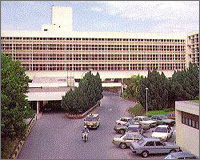 But it was so difficult to fall asleep in the common ward. The place was just too busy and noisy. Moreover, I had yet to get used to the bed and the environment.
Tired and upset, I called the nurse and asked whether I could be put in another ward, at least in the Second Class where there would be less people and less noise.
I must concede I made the enquiry in a not-so-friendly tone. "Nurse," I started, "the doctor admitted me to the hospital to rest but how can I rest with people coughing, sneezing, snoring, vomitting and farting around me?"
She replied politely, "Yes, you can request to go to First Class or Second Class. But you have to wait till morning and join the queue."
So I was stuck in this big, noisy and uncomfortable environment, at least till the morning. Then I might as well make good use of the time there and stop whining, I told myself.
A quick survey of the ward indicated that there were about 50 patients. The ward was partitioned into five sections and cramped with 10 beds each. It was meant to accommodate eight.
I was earlier referred to the general hospital by my family doctor after I've complained of breathing difficulties.
The medical officer at the Emergency Room admitted me immediately for what she said was for "observation and tests". So here I was.
A 'discovery' for me
Tiredness and boredom enabled me to finally get some sleep and when I awakened, it was only 3 am. Even though I managed to sleep only some three hours, I had rested and decided to walk round the ward. And I was sure glad I did. It was a 'discovery' for me!
You see, visiting a sick relative or friend in the hospital is totally different from being a patient there yourself. You need the time and space to interact with others in the ward to really feel and understand how those less fortunate than you 'survive' when they are seriously ill in the hospital.
There were other patients who were also awake that morning. I chatted to two of them, found them to be open and friendly souls indeed.
I also observed closely the doctors and nurses at work in an open ward and can now understand better what they have to endure in dealing with the sick and dying under their care.
Three nights and four days later, this is what I've experienced and seen in the common ward, an experience you would not get with your extra ringgit in the First or Second Class ward.
You will see wives and mothers, tending to their husbands and sons, virtually 24 hours a day. That's a sample of unconditional love at its best.
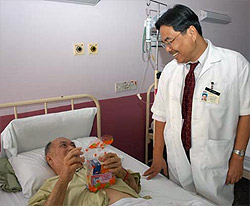 The 62-year-old man next to me has been coughing blood for over a week. His wife had not left his bedside over the four days I was their next-bed companion in the ward.
Across my bed, a 22-year-old college student was suffering from severe leg cramps and could hardly walk. His mother was always there for him by his side, constantly massaging his limbs to ease the pain.
You will see family members, relatives and friends of some patients turning up in large numbers during visiting hours. Then, there is the other contrast patients without a single visitor. These are lonely souls people without family or friends.
There was this 55-year-old asthmatic whom I've learnt was alone in the world. He might not have much but he did have his pride and dignity. He refused hand-outs and insisted on returning the RM1 coin he borrowed from me to make a telephone call earlier.
Quietly and professionally
You will see the young medical officers and nurses doing their very best in the ward. I must say I was pleasantly surprised that most of them had exercised patience and diligence in their work.
On Monday morning at about 1.30am, there was a death in the ward. An elderly patient had succumbed to his kidney ailment. The two young female doctors and the nurses handled the death quietly and professionally.
I believe there were only a few in the ward who were aware that someone had just passed away. Most of them slept through the episode.
On Sunday evening, some volunteers from the Punjabi Temple Association were in the ward distributing capati to the patients. I later learnt that this was carried out every Sunday where some of the wealthier Sikhs would distribute food to the sick as an offering. I also had a capati . Believe me, it's a nice feeling too to be on the receiving end of charity.
On Monday afternoon, two volunteers from the Kuala Lumpur Hospital library were in the ward distributing books and magazines to patients. I borrowed an old issue of Reader's Digest and was extremely glad that some kind souls thought of providing such a praiseworthy and healthy service in the hospital.
Of course, there are other experiences which I could have forgotten as I was discharged late Monday evening but suffice to say, I had spent a few fruitful and rewarding days of discovering things and people as a common man in the common ward of a common hospital.
I was sure glad that I did not pursue the idea of moving to the First or Second Class ward the next morning after I was admitted.
Otherwise I would have missed all these rich experiences and the friendship of some real people. The next time I have to be warded, you bet I'll opt for the common ward again.
FRANCIS PAUL now understands that hospital staff must always feel joy in their hearts amidst the sufferings and pains around them. Suggestions and feedback can reach the writer at [email protected]