
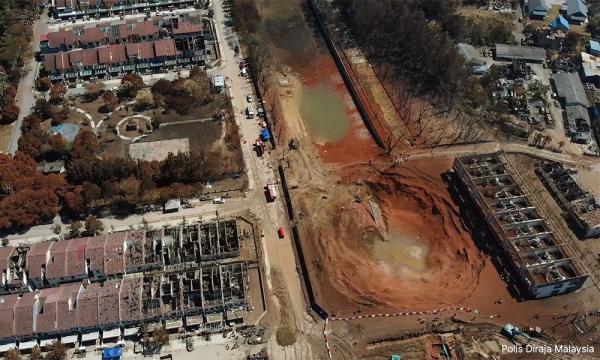

LETTER | As a union leader representing millions of hardworking Malaysians, including several victims of the recent pipeline incident in Putra Heights, I feel compelled to speak out. Not for politics. Not for drama. But for fairness, justice, and the human cost behind every headline.
The explosion in Putra Heights should not be seen as just an infrastructure failure - It was a tragedy that tore through homes, hopes, and the quiet dignity of retirement and family life. Among the affected were men and women who once clocked in daily to build this nation - workers, some of whom are union members, now left with nothing but uncertainty.
To these victims, I extend my deepest empathy. But empathy must be matched with action.
I call on all employers, whether public or private, whose staff were affected, to step forward. Financial assistance, paid leave flexibility, and access to counselling should not be optional. These are not mere benefits, but a show of humanity. The trauma endured, physical and psychological, is profound. And no employee should have to carry that alone.
To the credit of Petronas, I acknowledge their early and consistent efforts in medical aid, housing assistance, and community engagement, which I had only just discovered. The assistance that they had extended was never told.
As someone who has often been critical of large corporations when needed, I say this without bias - Petronas has acted with a sense of corporate duty that goes beyond the usual playbook. Their CSR support, proactive safety reinforcements, and willingness to face the media and public deserve recognition.
From conversations with several residents, one recurring frustration stands out: many of them were unaware that a high-pressure gas pipeline ran just metres from their homes, at the time they bought their houses.
Understandably, homeowners believe they deserve access to such vital information at the point of purchase, not only to make informed decisions but also to prepare themselves and their families for potential risks. After all, the pipeline had existed for decades prior to the development.
This concern raises an important and wider question: when critical infrastructure, whether pipelines, electrical substations, high-voltage transmission lines, rail corridors, water treatment facilities, or telecommunication towers, exists or is planned near residential areas, what safeguards are in place to ensure future homeowners are fully informed?
If no legal obligation exists to disclose such proximity, perhaps it's time for policymakers to revisit this gap.
In situations like Putra Heights, affected residents are not merely seeking compensation; they are calling for dignity, transparency, and acknowledgement.
While Petronas Gas Berhad has stepped forward with meaningful support, there is also hope that other parties involved will do the same. Not out of blame, but out of shared commitment to those whose lives have been disrupted. Ethics and empathy, not just compliance, must guide the way forward.
I also urge agencies like Socso to consider a special support scheme for workers who have lost homes or suffer trauma from such incidents – these are not ordinary situations and need an extraordinary response.
Financial institutions, too, should step up with interest-free moratoriums or flexible loan restructuring for affected homeowners. This is a moment for real compassion and shared responsibility, not just policy compliance.
We must ask how a high-density housing project was ever approved so close to critical infrastructure without a clear buffer zone or transparent urban planning. The official inquiry’s vague attribution to “soil movement” offers little clarity - it neither identifies a root cause nor assigns responsibility.
What led to the soil softening? Were proper geotechnical tests done before the pipeline was laid? How much did past and recent development works contribute to land instability? These questions remain unanswered. Without them, public trust will remain fragile, and future planning risks repeating the same oversight.
Meanwhile, some politicians have seized the moment, calling for Petronas to be held solely accountable. While it may earn them applause from the gallery, such one-dimensional blame is both unjust and misleading.
We cannot allow this tragedy to be reduced to a scapegoating exercise. The narrative must evolve from “Who can we blame?” to “What can we do, together, to help the communities impacted move on?”
This is not about absolving anyone. If Petronas is found at fault for any operational misstep, so be it - let the consequences follow. But let us not shield other potentially responsible parties by focusing blame too narrowly.
We are entering an era where critical infrastructure and residential zones are increasingly entangled. Urban resilience can no longer be the sole burden of utility operators. Developers, local councils, planners, regulators - all must be part of a holistic risk framework.
The residents of Putra Heights, including many workers and retirees, deserve more than sympathy. They deserve answers. And they deserve action. From everyone.
Because if this tragedy is buried under bureaucracy and finger-pointing, the next one may already be in the making.
SHAFIE BP MAMMAL is president of UNI Malaysia Labour Centre.
The views expressed here are those of the author/contributor and do not necessarily represent the views of Malaysiakini.