


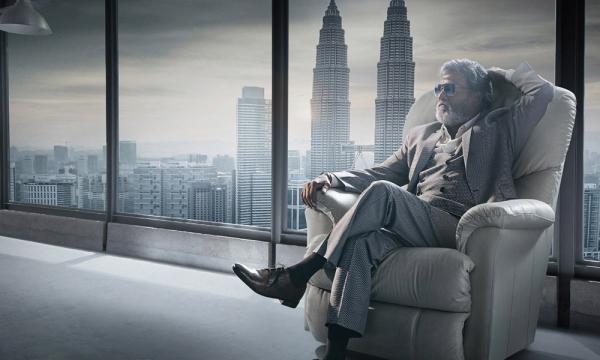

The thing is this. When I go to see a Rajinikanth movie, it is not just a movie experience that I get. It is far more than that, because watching a Rajini movie is like taking a walk down Memory Lane. Like flicking through old family albums and remembering the good times.
When I went to see ‘Kabali’ recently, I remembered seeing his movies in the past with my loved ones; some of whom are no longer here today. The memories become all the more precious. I have watched Rajini’s movies with my grandparents; my parents; my husband; family members and friends; and now with my own boys in ‘Kabali’. How many actors can span four generations like that? This is just one of the reasons why Rajini is a living legend.
When we see a Rajini movie, we are actually, either consciously or unconsciously, revisiting a part of our own lives. I recall watching ‘Netrikann’ in Coimbatore, India in 1981 when I was a child, with my brother and parents. We all laughed so much till tears trickled down our cheeks. My father passed away more than a decade ago but this mischievous and delightful movie always reminds me of him.
Rajini acted in a dual role here as both a womanising; male chauvinistic husband and also a filial, responsible son. Directed by Rajini’s mentor, the late and great K Balachander, this, together with his ‘Thillu Mullu’ (1981), where he acted with the late ‘Thengai Srinivasan’ and Sowkar Janaki, are classic and timeless comedies that anyone of any age can watch, again and again.
The addictive melody from ‘Thillu Mullu’, sung by SP Balasubramaniam, resounds in our heads, capturing Rajini’s cheeky character as the philandering and hilarious father. Rajini in comedy is simply priceless.
He can turn even horror into comedy, which he effortlessly did in his trademark manner, delivering punchline dialogues with a poker face, in ‘Chandramukhi’ (2005) . His snake jokes in ‘Annamalai’ (1992) and ‘Padaiyappa’ (1999) are unforgettable and can bring a smile to the most weary and cynical cinema goer.
I must admit that the lack of comedy is something which I missed in the recent ‘Kabali’. Apparently Rajini asked whether some comedy could be introduced into the movie, but Pa Ranjith, the director was not too keen; and Rajini, being the humble man he is, quietly agreed to let the director have his way. That is the kind of man he is, which contributes to his popularity that spans generations, classes and hugely different communities.
When you watch a Rajini movie, you will witness a seemingly impossible feat; namely, the ‘Rajini Cinema Equaliser’ - where everyone is reduced to just one group - simple Rajini fans.
Another reason why Rajini is irreplaceable is because of the music and songs we associate his movies with. He has given us the soundtrack to significant parts of our lives. I remember ‘Muthu’ (1995) as the movie playing at the time of my wedding ; and in my head I can still hear the sweet crooning of SP Bala set to AR Rahman’s compositions (“Hey hey hey hey hey hey …. “ - the opening notes of the song ‘Oruvan Oruvan Muthalali’). Which Rajini fan can forget how he whistles, jumps on the chariot with the two white horses and sings lustily?
Amazing soundtrack; superb lyrics; spectacular scenery of a lush green Tamil Nadu - what’s there not to like ? When I listen to the ‘Thilana Thilana’ song in that same movie, the lyrics are special and personal to me, because they remind me of a time when I was starting a new chapter of my life. And Rajini is part of the soundtrack to it.
I remember smiling at the way he dances - his back and knees stiff, nothing like the flexible dancers of today. Though he is not a naturally graceful dancer, he tries his best for his audience, and it is very endearing. Song, dance and a deep love for music throbs in our Indian blood, and Rajini’s movies have delivered timeless and consistent hits over the years.
I must admit, though, that I like his coupling with the great SP Bala best. The melodies stay in your heart, taking you back to different times and places in your life.
Raw anger of youth today
The music in ‘Kabali’ is very different, emanating the raw anger of youth today. ‘Neruppudah’ has already become iconic, and it must be applauded, together with the other songs in ‘Kabali’, for giving many Malaysian rap artists the opportunity to showcase their enormous talent and putting them on the international radar, somewhere they deservedly belong.
Kudos to Santosh Narayanan, the composer, and his team, for delivering a musical style which is startlingly different, original, raw, dynamic and pulsating. It leaves a throbbing in our heads.
Anyone who says that Rajini cannot do romance is gravely mistaken. In ‘Kabali’, for instance, there is no mistaking that Kumudhavalli is the love of his life. Her image constantly haunts him and he sees her everywhere, which results in a criss- crossing of flashbacks throughout the movie. The song ‘Maya Nadhi’ captures this beautifully, and the way he looks at her in the Auroville scene in Pondicherry, as she is making the bed, will send goose bumps up your spine.
Another such bitter sweet moment is when he looks at Shobana, his initial love interest in ‘Thalapathy’ (1991), when he knows that he will not be able to marry her. Caste, that ugly monster, rears its head in many of his movies, to damn the lovers.
In ‘Kai Kodukkum Kai’ (1984) he adores his blind wife, played by Revathi. The loving way he looks after and adores her will leave no doubt in any woman’s mind - Rajini can definitely play the romantic hero. He can make any woman swoon. Even today, at 65.
He can also do emotional scenes that pull at our heartstrings. In the scene where he meets his wife after 25 years, in ‘Kabali’, the look of pain when he finally sees her; when she enters the room where he is waiting; will make you want to cry.
And when he hugs Kumudhavalli at their reunion, I was strongly reminded of another girl called Valli, in another movie, way back in 1978, ‘Mullum Malarum’, one of my personal favourites. In this movie, where he acts with the late Shobha, they are orphans. He looks after his sister as though she is the most precious gem on earth. Unfortunately for him, she eventually falls in love with his nemesis. They decide to get married without telling Rajini.
By this time in the movie, he has become an outcast - amputated arm, unemployed; alone and devastated. Sacrifice, a recurring Rajini theme, is painfully seen. At the climax of the movie, however, Valli comes running back to him and realises that she cannot live without her brother. He forgives her and they embrace; and it is clear to the audience that the love they share is so strong that no one can touch them.
Rajini movies also, contrary to what the critics and prophets of doom say, make us think. Sure, they are commercial blockbusters, but they do contain recurring themes that are timelessly appealing.
The rags to riches plots inspire people to feel that anything is possible; that though life is hard, anyone can be successful if they try or work hard enough. That money cannot buy you happiness, peace or contentment. That the love of your life is there waiting for you; that there is a soulmate for each and every one of us. That loyalty and sacrifice are part and parcel of life.
Think of many Rajini movies such as ‘Annamalai’ (1992), ‘Muthu’ (1995), ‘Padaiyappa’ (1999), and ‘Arunachalam’ (1997), where betrayal often comes from those closest to you - but you fight back, and you learn to forgive.
The importance of family - he always treats his mother with utmost respect and love (which mother can hear the ‘Amma’ song in ‘Mannan’(1992) and not want a son like that?) and friendship (like Karna in the epic ‘Mahabaratha’, he sacrifices everything for his beloved friend in Mani Ratnam’s gem of a movie, ‘Talapathy’ (1991)).
A take-home message
In his films, good ultimately triumphs over evil. Which is why in ‘Kabali’ there is indeed a take-home message; if you choose to look for it. And that is that gangsterism does not pay at the end of the day. It causes violence; unimaginable tragedy and tears families and society apart. ‘Kabali’ is also particularly meaningful to me as an Indian Malaysian as it highlights significant social, economic and political issues in contemporary Malaysia.
The plight of Indians in this country is painful to watch. The movie conveys the struggles of migrant Indians in this country, and the various injustices and atrocities that were committed against them both in the past and also in the present.
However, it goes on to give the more important message - and that is the importance of education. How vital education is in order to rehabilitate and bring the Indian youth in this country out of their vicious circle of poverty, gangsterism; drugs; prostitution ; alcoholism and other social ills.
Sure, the movie is indeed extremely violent, but what can one expect from a movie about gangsterism? Is it ugly? Undeniably. Do we have a serious problem with Indian gangs in this country? Yes, we do. That is the brutal and terrifying reality of the state of things in Malaysia today.
Besides doing genres of adventure, action, drama, crime, tragedy and comedy, Rajini can also play the supreme villain . If you have not seen him as the bad guy, all you have to do is go back to 1975 and watch ‘Apoorva Ragangal’, where he was introduced to Tamil cinema by his mentor, the director K Balachander.
That, together with ‘Aval Oru Thodar Kathai’ (1974), ‘Moondru Mudichu’ (1976), and ‘16 Vayathinile’ (1977) - feature vintage Rajini at a very young age playing the villain brilliantly. Brooding, dark and controversial characters which will make you question acceptable societal norms of the day.
Over and above being an actor, he is also an inspiration and beacon of hope to so many people. Born as Sivaji Rao; from a humble bus conductor in the Bangalore Transport Service in Karnataka, he came up the hard way, and toiled hard to become what he is today : one of the highest paid actors in the world (in ‘Enthiran’ (2010) he was paid US$11 million).
Despite the lofty heights he has achieved, however, he has not lost his humility, simplicity and charm; something rare in the glamour and tinsel of celebrity life. When his films don’t do as well as predicted, for instance ‘Kuselan’ (2008), he replaces the losses by indemnifying the distributors personally. In a changing world, Rajini has remained true to himself and his audience. In fact apparently even his waistband size has remained the same since 1975!
See how he walks in ‘Basha’ (1995), a classic Don movie, and you will see many parallels between ‘Basha’ in 1995 and ‘Kabali’ in 2016, two decades later. His style; the way he walks, the way he whistles, the intense stare into the lens of the camera, locking eyes with the audience in a mesmerising manner. All of this has remained the same; and we love him for it.
Inimitable style
He has over the years trademarked his own actions and gestures, creating an inimitable style (who else can flip their wrist, sunglasses or cigarette the way he does?) of cinema dialogue; punch-liners and stunts that no one else can outdo. This; coupled with his quiet philanthropy, generosity, spirituality and his remembrance and respect for his roots and his audience means that he will always have a special place in our hearts.
He is, quite simply, an irreplaceable treasure. A living legend. Also, as Rajini fans, we are all quietly aware that the clock is ticking away. He is 65 years old. He is not invincible. He was gravely ill recently, in 2011. So any Rajini film is a precious thing to us, which we will file away in our heads and hearts and gratefully receive.
After all, the least we can give him back is our gratitude for what he has given us endlessly over four decades. His priceless gift of entertaining and unforgettable cinema.
At the end of the day, life is nothing but a block of Lego, and we are constantly building memories. Rajini has undeniably helped us immeasurably in that process. He has given us happiness. I guess his one word in ‘Kabali’ sums it up perfectly: “Magizhchi”.
MEERA BADMANABAN has been a Rajinikanth fan for the last four decades and for life.